
Polish jewelry exhibition in the National Museum in China

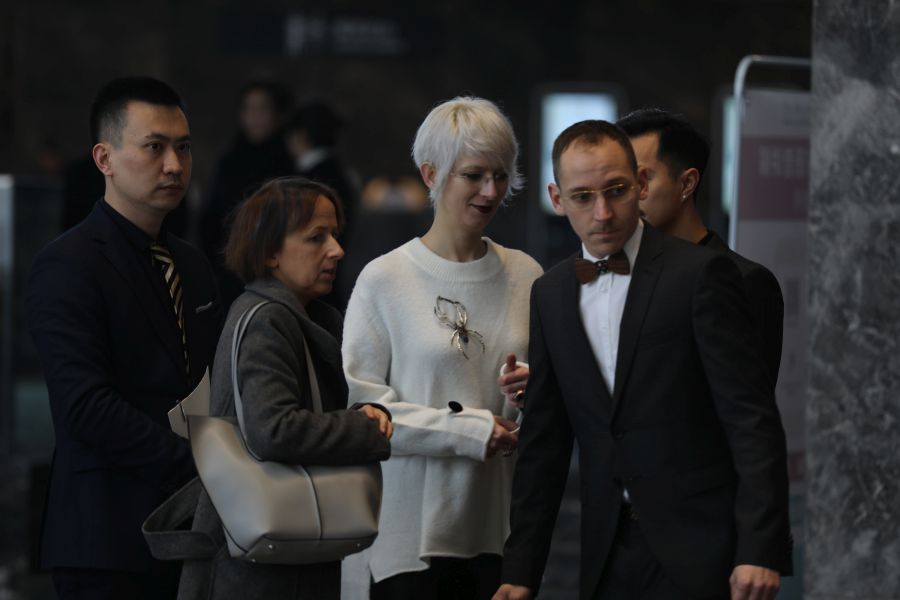
The General Consul of Poland in Chengdu, Iwona Tamborska, Sebastian Tajl
The 23 January 2018, in the Guizhou National Museum (China), city Guiyang (1,2 mln people) was the date of an official opening of the Polish Amber Art Jewelry exhibition “Beauty trapped in time”. It was organized by the initiator and the curator of the exhibition- Sebastian Tajl, who involved into cooperation the National Museum in Guizhou Province, General Consulate of the Republic of Poland in Chengdu, International Association of Ambermakers and Polish Tourist Agency. Just after the official opening, the exhibition was enrolled on a list of the best cultural events of January 2018 in China. At the same time it is the biggest Polish jewelry exhibition in whole Asia.
To fully comprehend the scale of this event, one should be aware, that the Chinese side invested into organising this event about 500 000 RMB. As the “cherry on the top” I was asked to come as one of the artists, whose 3 works take part in the exhibition (silver&&bronze Chess Pieces, Triptych – the finalist piece of the Saul Bell Design Award http://www.saulbellaward.com/2017-winners/ and necklace: “We’re all broken inside”). But in my own opinion, my most important job was to create a mural, side by side with young Chinese artists as a form of international cooperation. The mural was telling a story of amber.

We’re all broken inside – necklace by Iwona Tamborska
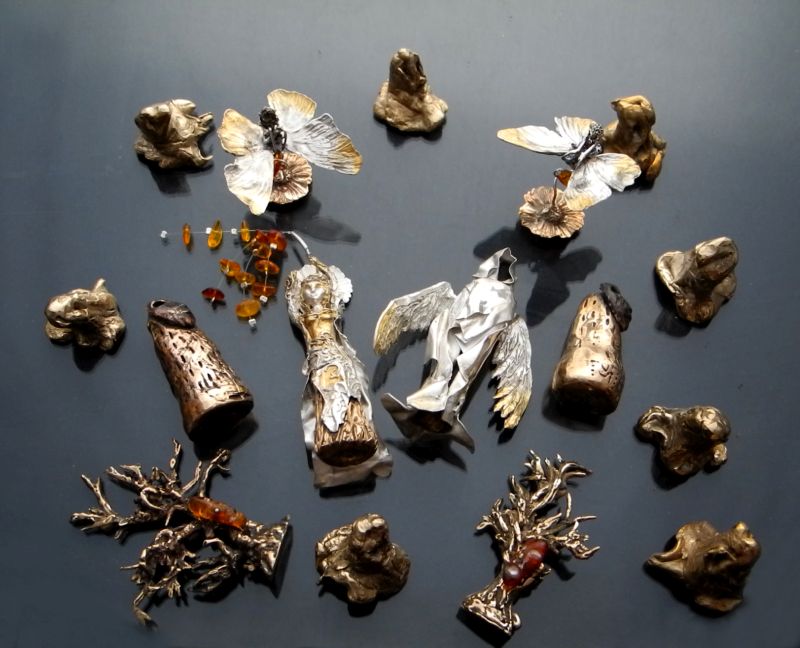
Chess pieces: silver and bronze; White Army by Iwona Tamborska

Triptych – Saul Bell Design Award 2017 finalist
These are some links to publications about the exhibition:
Oraz link do artykułów w polskich mediach:
3. https://m.deon.pl/wiadomosci/swiat/art,30785,chiny-wystawa-polskiego-bursztynu-przyciaga-dziesiatki-tysiecy-ludzi.html
Let me start my story from the exhibition itself. I wanted to thank from the bottom of my heart for the unique engagement in creating such an event. I have never seen a jewelry exhibition treated with such a respect and glorification. Sebastian Tajl and Jack Yang even put the highest attention to such details like the right shade of material’s colour which would correspond with the jewelry. When the jewelry displayers turned out not to be pleasing enough, they engaged the museum’s workers to manually saw blue velvet pillows and personally covered the new displayers with the velvet, working long late hours in the Museum. (The pictures were given to me by Sebastian Tajl).
The amount of work put into organising this event, attention to smallest details (Chopin’s music being played 24/h in the exhibition hall), the work given to creating beautiful book-like-catalogues, charming invitations and an official “Thank You” letter from the State Institution, inviting special guests (like high Government Officials, Polish General Consul, etc.) is just enormous. In the name of artists, whose works were chosen to take part in this exhibition, I would like to say I feel extremely appreciated and incredibly grateful. I would also like to thank Jack Yang, who personally attended to exhibiting the jewelry pieces in a way, that shows their beauty at fullest. Jack was also the key person when it comes to communication and cooperation between 2 cultures, who at the same time took upon himself a part of a translator and a PR person for the contact with media, for what he deserves a special amount of gratitude 🙂
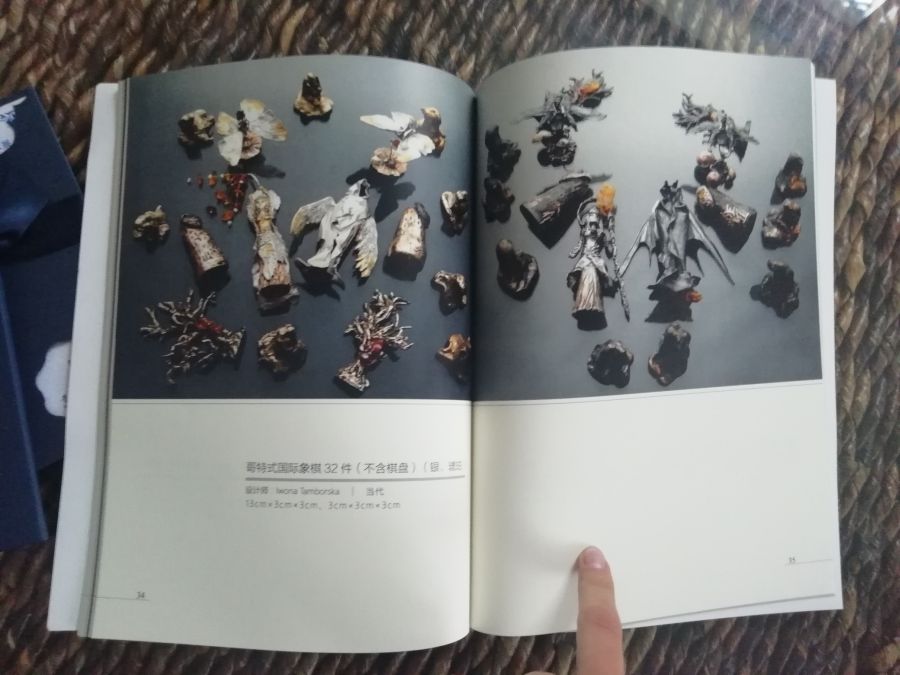
Catalogue from the exhibition “Beauty trapped in time” – chess pieces by Iwona Tamborska
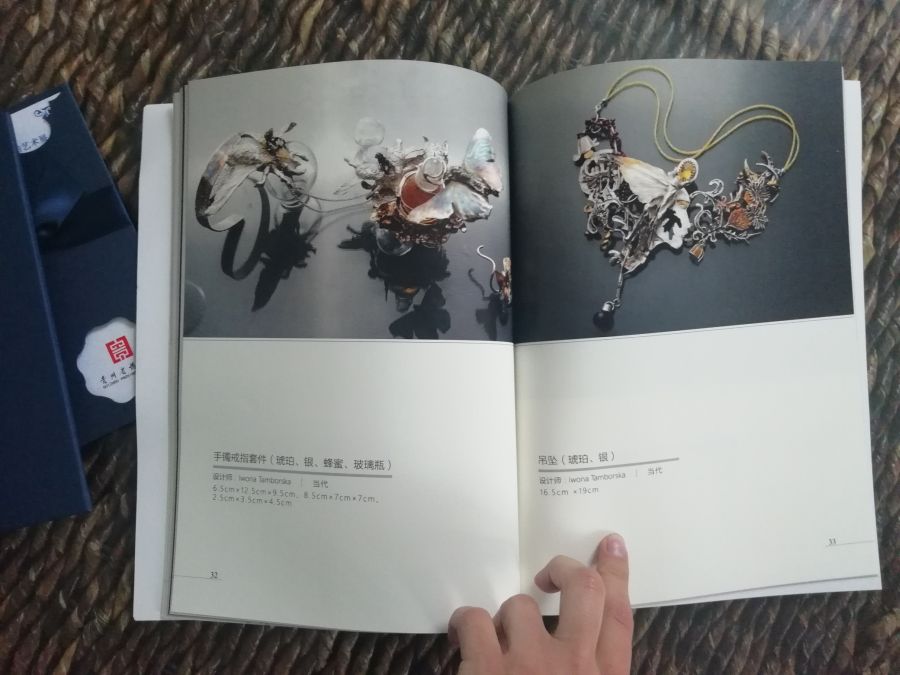
Catalogue from the exhibition: Beauty trapped in time: Tryptych and “We’re all broken inside-necklace” by Iwona Tamborska
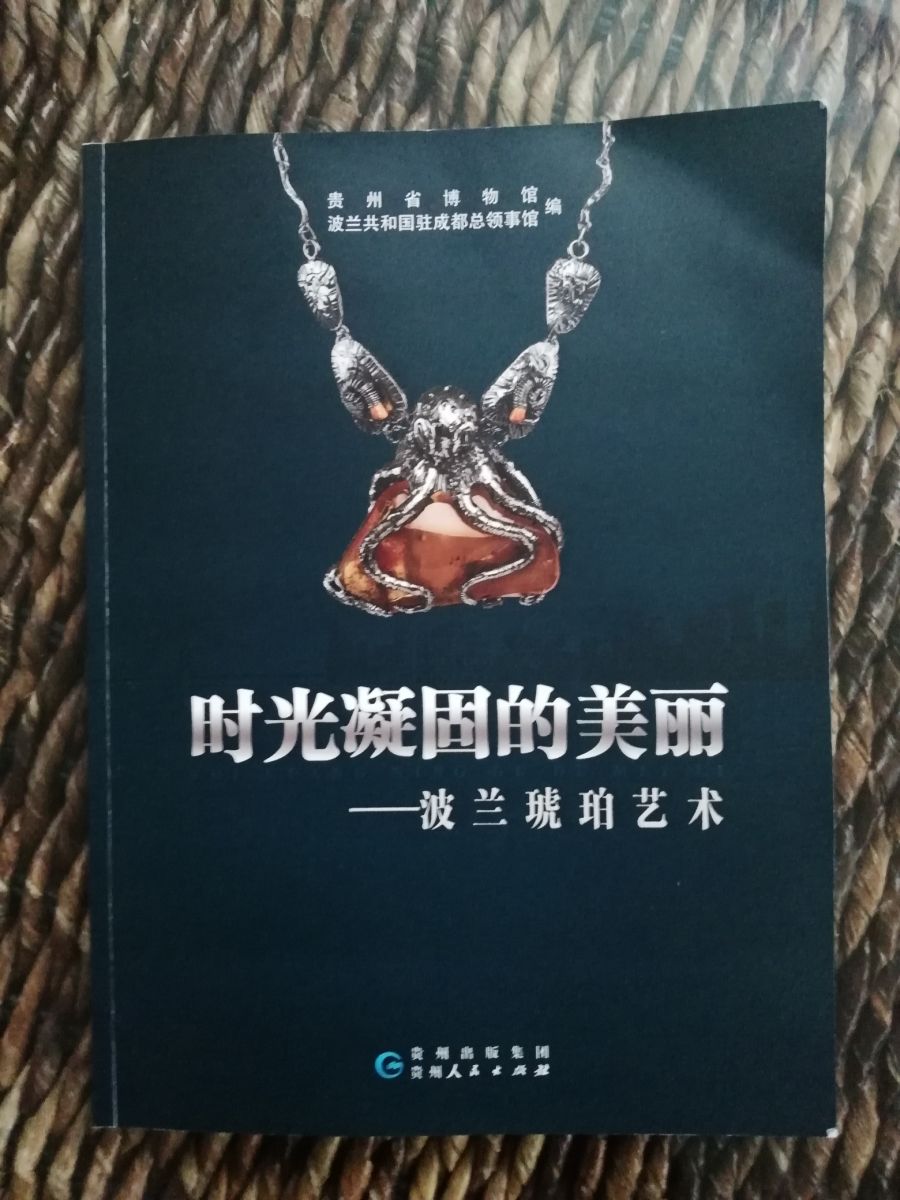
Catalogue from the “Beauty trapped in time” exhibition, 2018 National Museum in China, Guizhou
The opening ceremony was impressive. It started with a concert of a Chinese pianist, who was playing Chopin and a dance show of an ethnic group from Guizhou Province. Then a whole list of important speakers (the General Consul of Poland, president of the city, directors, etc. – please forgive me, but I am not very good with remembering titles, positions and things related). I would just like to point out the building of the Museum and the ceremonial room itself: the huge walls of the room were decorated with enormous rock fossils of dinosaurs and fossiled plants. If someone is aware how much those things cost (millions!!), then that one would understand this event’s splendor.
I was able to watch the opening ceremony for some time, but then I was asked to quickly go to the exhibition gallery, in front of which we were painting the mural. I had to be fast to get there on time for all the interviews with the media. And there were numerous interviews and pictures. A lot of pictures. It turned out, that my white hair and big nose are considered as very beautiful in China and everyone wanted to take a photo with me and publish it on their WeChat (Chinese facebook), which I have now as well.
Now a few words about the mural:
I am the author of the design, but I really wanted for it to combine the creativity of two cultures. It took us a little while to break through the “first ice” and shyness, but the students from the Academy of Art in Guizhou Province swiftly understood what I asked them to do and to add to the mural from their imagination. That is why the mural (which is about 60m2) is full of Chinese culture’s accents, Guizhou ethnic patterns and Polish motives. We were having really great fun, even though I didn’t speak Chinese and they didn’t really speak English. From time to time we were saved by the translator, but it turned out, that when it comes to art, there are no language barriers. If only the atmosphere is good, people are willing to communicate and to create something – “things happen on their own”. Let me just add, that some elements of the mural, that symbolize amber, are decorated with gold and copper foil.
The main thought behind this project was the creation of amber as a resin, that came out of trees and after millions of years hardened in the sea depth’s, how the amber was fished out and polished due to the fact it has always been considered very precious, the different kinds of amber and its inclusions, which make it highly wanted and expensive. The central point of the design is the king and the queen, who wear jewery with amber, that accents their high status, the creation of amber routes which led even to China, through the Great Wall to the Guizhou Province, where now in the National Museum (which building is a landmark) an exhibition about the amber and amber jewelry is being held. The design is quite surreal, kept in comic-book drawing style, full of intricate, hidden details which brought fun to the artists hiding them, and to the audience finding those details.
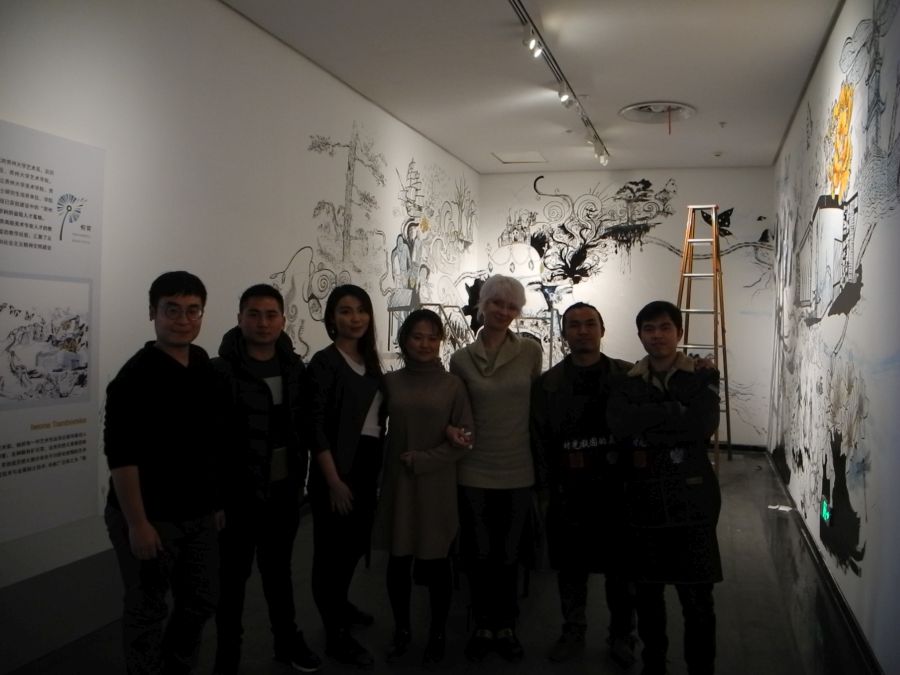
Iwona Tamborska and young Chinese artists in front of a mural in National Museum in Guizhou
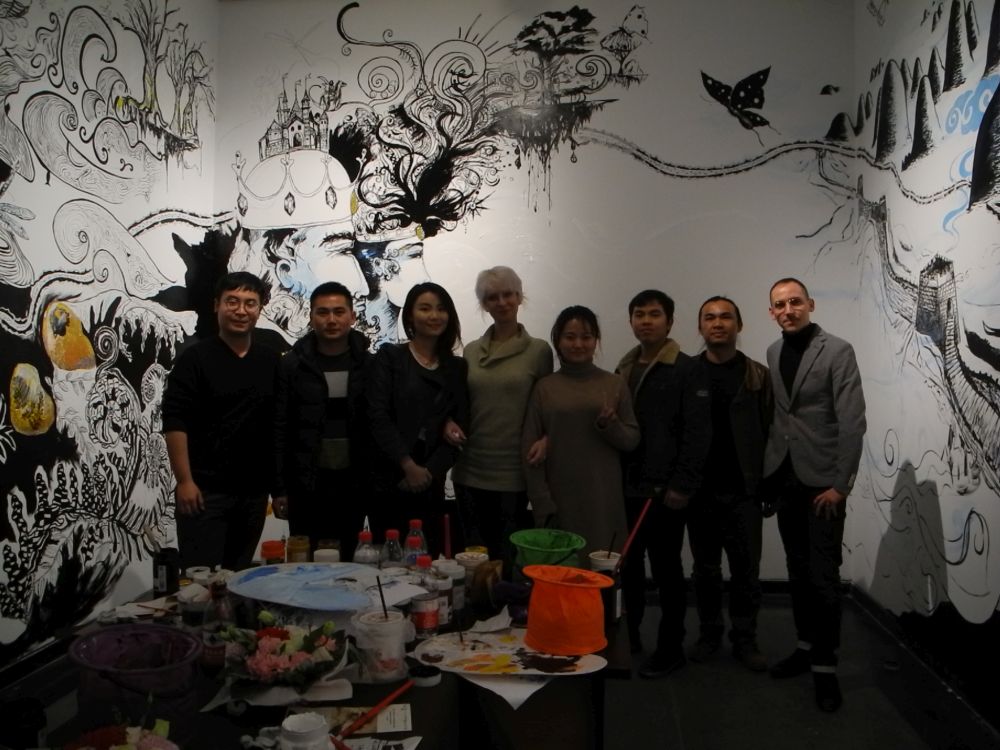
Iwona Tamborska and young Chinese artists in front of a mural in National Museum in Guizhou
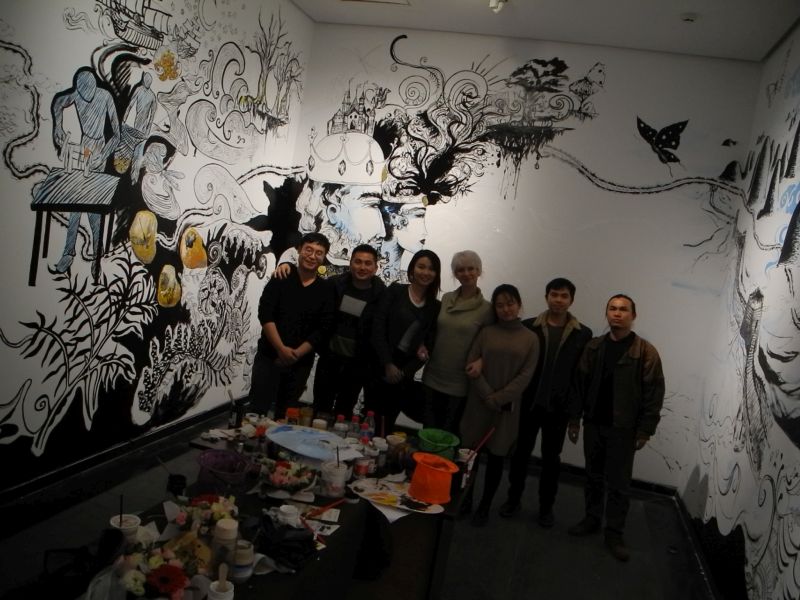
Iwona Tamborska and young Chinese artists in front of a mural “The Story of Amber” in National Museum in Guizhou
My third job, why I was chosen to fly to China, was to give a jewelry making show using the metal clay technique I specialize at. This is a modern jewelry making technique. I was suppoused to work next to a Chinese master of a traditional silversmithing technique of the Miao Zu minority, Mr Wu Shui Gen. I felt almost blessed, as Mr Wu Shui Gen is officially honoured by the UNESCO as the cultivator of the ancient way of working with the labourous technique of filigree. Moreover he explained to me, step by step, how he creates his miracle-like works. This situation is almost unbeliveable. How many modern jewellers from Europe will ever get a chance to learn such secrets? What is even more – I could try on a Phoenix crown – 0,5kg of pure silver in the filigree technique. Magnificient.
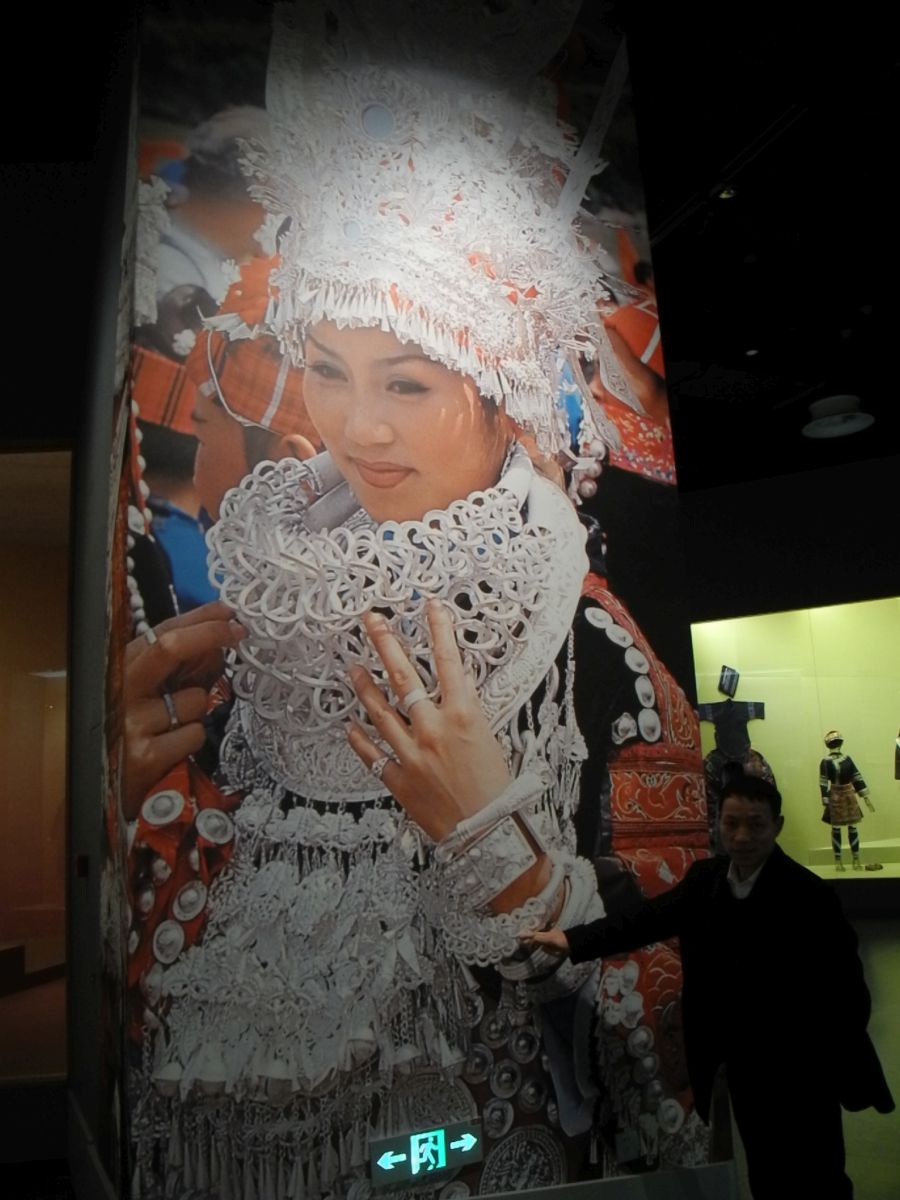
Ethnic silver jewelry from Guizhou province
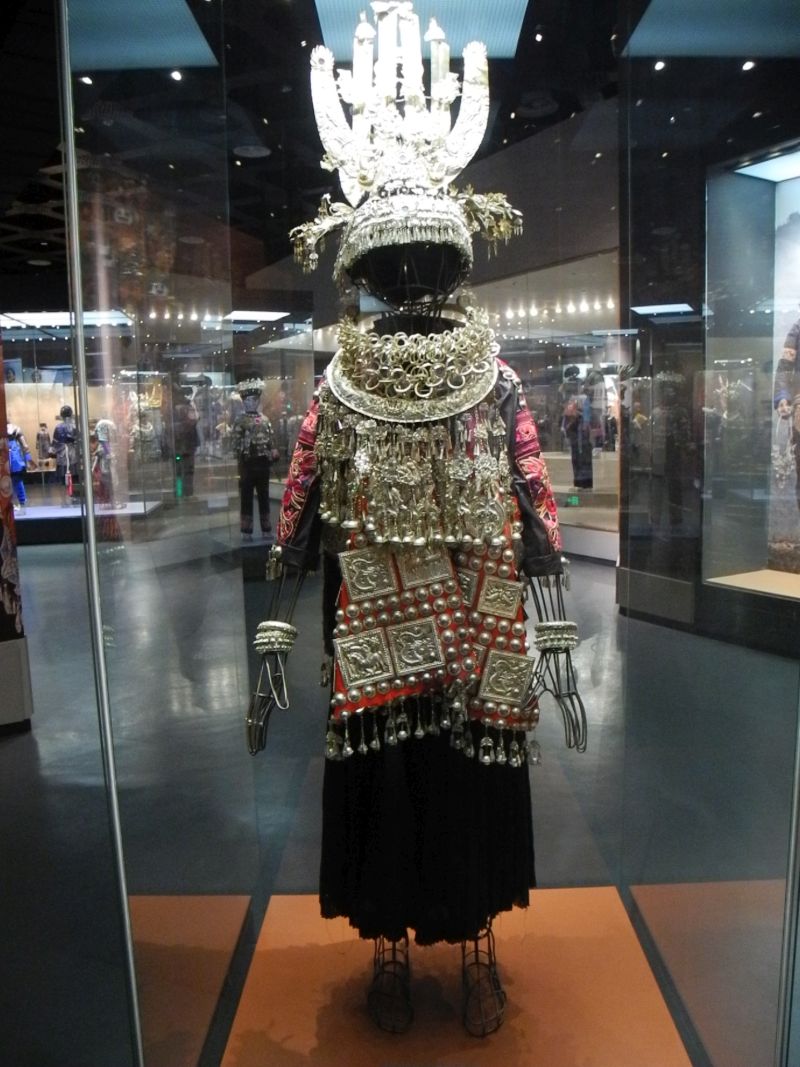
Ethnic silver jewelry from Guizhou province
And these are some shots from the Museum’s treasures, created with the filigree technique:
Also as part of the exhibition’s event a fashion show was held (with works of a Polish designer: Michał Starost), lectures about amber and special “open days” for children, teenagers and students that were suppoused to bring Polish culture closer to them.
As for myself – the whole time I spent in China, I have been treated as a queen. The amount of official dinners, that i have been invited for (including an unofficial dinner with the Polish Consul), heart warming hospitality of Sebastian Tajl and Jack Yang, the sincere and hearty attitude towards me of the Museum’s directors, workers and young artists made me feel, that even though my luggage got lost at the airport and I got really cold to the bone over those 2 weeks in China, I felt happy and nurtured all the time and I was able to experience new wonders almost every day in China 🙂
Thank you very much for that 🙂
Now some facts about the exhibition itself:
The opening ceremony was honoured by the presence of: The General Consul of the Republic of Poland in Chengdu, Director of the International Affairs of the Guizhou Province, Director of the International Affairs of the Guizhou Province – Europe District, Director of the Culture Department in Guizhou Province, Director of the Commerce& Investment Department in Guizhou, Director of the Historical Relics Department of Guizhou Province, v-ce President of the city of Kaili, director of the International Affairs of the city of Guiyang, director of Media Department in Guiyang and other representatives of the world of education, art and business. A day after the opening also the Province Governor arrived.
The exhibition presents over 240 art pieces of 51 exquisite Polish art-jewellers.
Exhibiting artists:
prof. Andrzej Szadkowski, prof. Sławomir Fijałkowski, prof. Andrzej Boss, dr Sergiusz Kuchczyński, Mariusz Gliwiński, Iwona Tamborska, Dorota Cenecka, Andrzej Kupniewski, Jolanta Kupniewska, Marcin Tymiński, Ela&Marek Pawłowscy, Maryla Dubiel, Tomasz Kargul, Danuta Czapnik, Dorota Gulbierz, Marta Włodarska, Tadeusz Dobkowski, Łukasz Ircha, Maja Woźniak, Jacek Ostrowski, Wanda&Bogdan Frydrychowicz, Margita, Emilia Górna, Bogusław Kołpak, Maria Fijałkowska, Daria Malicka & Maciej Wodnik, Jan Pomianowski, Paulina Binek, Ireneusz Glaza, Wiesław Kuś, Przemysław Kuś, Eryk Popkiewicz, Olaf Popkiewicz, Harald Popkiewicz, Ludwik Dumin, Narcyz Kalski, Adam Pstrągowski, Mariusz Drapikowski, Michał Starost, Irmina Fularczyk, Małgorzata Szewczyk, Emilia Kohut, Krzysia Staniszewska, Justyna Chodnikiewicz, Joanna Jarza, Joanna Mach, Katarzyna Ratajczyk, Patrycja Sieńkowska, Marta Kwapich, Małgorzata Rumińska, Ewa Nowak, Artur Wybacz